Should You Put Prices on Your Website? Why One Wedding Photographer Does
If you sell a service, you have probably argued with yourself about this. Do you put your prices on your website, or do you ask people to get in touch first? Most service businesses […]
Martelle PittsOctober 13, 2026 · 7 min read
If you sell a service, you have probably argued with yourself about this. Do you put your prices on your website, or do you ask people to get in touch first?
Most service businesses choose the contact form. We think that choice costs more than it saves. One of our clients, a Philadelphia wedding photographer, puts his prices right on the page, and his site shows how to do it well.
The short answer: for most small service businesses, yes, publish some form of pricing. The rest of this post covers why, when a range works better than an exact number, and how to lay it out.
Why most service businesses hide their prices
The reasons are understandable. We hear the same four from almost every owner.
“Every job is different.” A kitchen remodel or a legal matter doesn’t have one price, so it feels wrong to post any number.
“My competitors will see it.” They will. They can also call and ask, the same way a customer would.
“The price will scare people off.” Some people, yes. More on that below.
“I want to talk to them first.” The thinking is that a conversation lets you explain your value before the number lands.
Each of these protects you. None of them helps the person on your website, who has one question and can’t get it answered.
What putting prices on your website does for you
Think about the last time you shopped for a service and found “Contact us for pricing.” Did you fill out the form, or did you hit the back button and try the next result? Most of us do the second.
Putting prices on your website changes who gets in touch and how the first conversation goes.
It filters out poor fits
Someone whose budget is half your lowest price was never going to hire you. With no price on the site, you find that out after a phone call, a site visit, or a written quote. With a price on the site, they find out in ten seconds and nobody loses an afternoon.
That is the fear from the last section turned around. The price does scare some people off, and those are mostly the people you could not have helped.
Good fits arrive informed
The people who do contact you have already seen the number and decided it works. The first conversation can start at “which option is right for me” and skip “how much is this going to cost.”
It builds trust before you speak
A hidden price makes people wonder whether the number changes depending on who is asking. A visible one tells them everyone gets the same deal. For a small business competing against bigger names, that openness is an advantage that costs nothing.
A real example: Vlad G Photography
Wedding photography is an industry where almost everyone hides the price. The usual approach is a beautiful gallery, a line that says “inquire for our collections,” and a form.
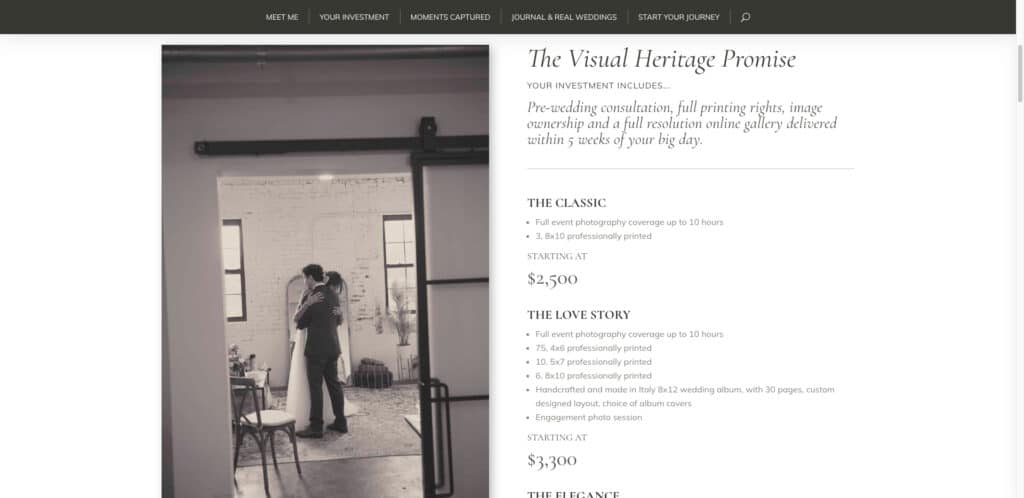
When we built the website for Vlad G Photography, a wedding photographer serving Philadelphia and the Main Line, the pricing page went the other way. It shows:
Three packages with real numbers. No ranges and no “starting at.”
What each one includes, down to the album size and the number of prints.
A clear next step. The inquiry form asks for both partners’ names, the wedding date, and the venues, so Vlad’s first reply can be specific.
A couple who cannot afford him knows before they write. A couple who can already knows which package they are leaning toward. You can see how it reads on his pricing page.
Notice what makes this work. Wedding photography is a custom service, and no two weddings are the same. Vlad still found a way to package it into three clear options. Most service businesses can do the same with a little thought.
When a range or “starting at” works better
Exact prices are not right for every business. If your work varies a lot from job to job, a single number can mislead people. You still have options short of hiding everything.
Approach
Good for
Example
Exact prices
Services you can package the same way every time
“Furnace tune-up: $129”
Starting at
Jobs with a clear minimum and add-ons
“Logo design starting at $750”
A range
Projects where size drives the cost
“Most bathroom remodels run $12,000 to $25,000”
Typical project
Fully custom work
“A recent backyard patio, 300 square feet with a fire pit, cost $9,400”
The figures in that table are made up to show the format. Use your own.
Even the loosest of these answers the visitor’s real question, which is “am I in the right ballpark?” That is usually all they need before they are willing to call.
If you use a range, say what moves a job toward the top or the bottom of it. Square footage, number of pages, rush timing, and materials are the usual ones. That one sentence saves you from explaining it on every call.
How to show prices on your website so they sell
A bare number invites comparison with the cheapest option in town. A number with context shows what the customer gets. Five things make the difference.
Say what is included. List it plainly under each price. Vlad’s page names the album size and print counts, so nobody has to ask.
Say who each option is for. “Best for small weddings” or “For homes under 2,000 square feet” helps people choose without calling you.
Offer two or three options. One price is a yes-or-no question. Three options turn it into “which one,” and many people pick the middle.
Put proof nearby. A review or a photo of finished work next to the price reminds people what they are paying for.
Give one clear next step. A button under each option that leads to a short form or a booking page.
Keep it current, too. A price list from two years ago causes more awkward calls than no price list at all. Put a reminder on your calendar to review the page every January.
Common questions about prices on your website
Should I put prices on my website if every job is custom?
Yes, in some form. Use a starting price, a range, or the cost of a typical project. Visitors want to know if they are in the right ballpark, and any of those tells them.
Will my competitors use my prices against me?
They can already find out by calling you. What they cannot copy is what sits beside the number: what is included, your reviews, and your finished work.
Will showing prices lower the number of leads I get?
You may get fewer inquiries. The ones you lose are mostly people whose budget did not match, so you spend less time on quotes that go nowhere.
Where should the pricing go?
Give it its own page and link to it from the main menu. Label it “Pricing” or “Rates” so people and search engines both know what it is.
How often should I update my pricing page?
Any time your prices change, and at least once a year. Out-of-date prices cause more problems than no prices.
The bottom line
If a visitor leaves your website without knowing roughly what you cost, many of them won’t come back to ask. Publish something: exact prices if you can package your work, a range or a starting point if you can’t.
You will hear from fewer people who were never going to hire you, and the ones who do reach out will be further along.
Want a pricing page that does this for your business? It is part of how we approach website design. Get a proposal and tell us what you sell. We will show you how we would lay it out.
Is your site making these mistakes?
We'll do a free 30-minute review of your current website. No pitch and no pressure, just an honest look at what's working and what isn't.
Martelle Pitts is a multifaceted small business owner, blending a background in Information Systems & Technology with a deep passion for creativity. From designing innovative solutions to crafting melodies and code, Martelle thrives on the intersection of technology and artistry. With a keen entrepreneurial spirit, Martelle is dedicated to driving excellence in both business and creative endeavors, continually seeking new avenues to bring ideas to life.